Heat Pump Installers Across Wales, The Borders and The South West
We design and install high performance air source and ground source heat pump systems for homes, farms and rural properties across Wales, the Welsh borders and the South West of England.
Serving Wales, The Borders and The South West
Many properties across Wales and the border counties are rural, off grid or previously heated by oil or LPG. Heat pumps provide a cleaner and more efficient alternative, removing the need for external fuel tanks and regular fuel deliveries.
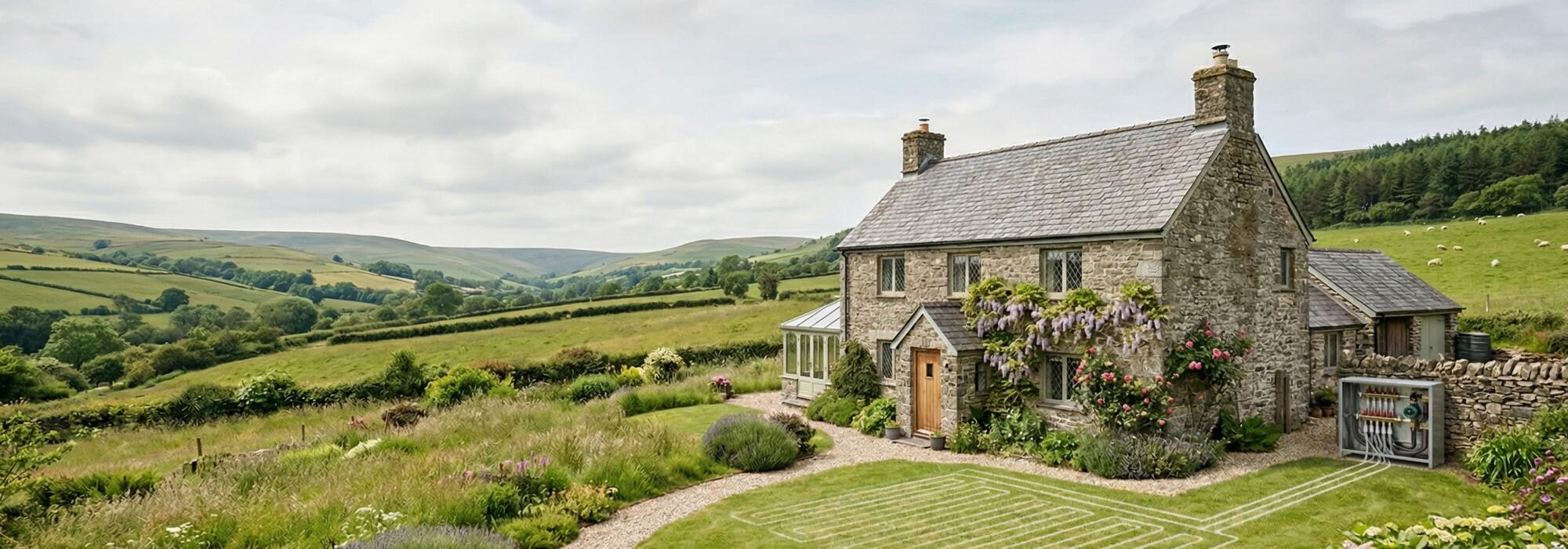
From countryside cottages and farmhouses to larger detached homes, we design bespoke systems that suit the building and its heating demand. Ground source systems are particularly well suited to properties with available land, while air source heat pumps offer a straightforward retrofit option for many homes.
Claim up to £9,000 Government Grant
Check if you qualify for up to £9,000 in government support for a heat pump installation.
See your options now and get expert advice tailored to your home.
Check My Eligibility
Renewable Heating for Rural and Off Grid Properties
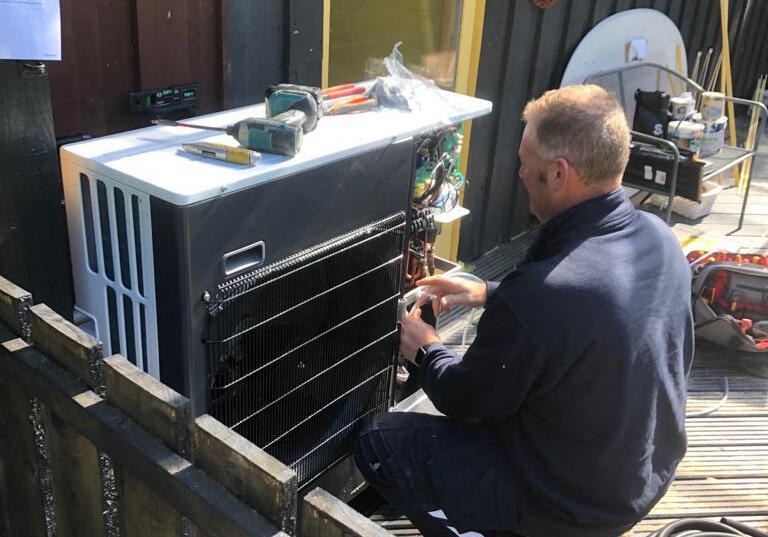
Heat pumps are becoming an increasingly popular alternative to oil and LPG boilers across rural Wales, the border counties and the South West. They are particularly well suited to countryside homes and properties without access to the mains gas network. By switching to a heat pump, homeowners can remove bulky external fuel tanks, ageing high emission boilers and the inconvenience of arranging regular fuel deliveries.
For rural and semi rural properties, heat pumps provide a cleaner and more efficient way to heat your home. They offer a sustainable, low carbon solution while delivering consistent indoor comfort and reliable hot water throughout the year. Thanks to modern engineering, both air source and ground source systems integrate seamlessly with radiators and hot water cylinders, allowing you to move away from fossil fuel heating without compromising performance.
Although demand continues to grow across the UK, this is not new or experimental technology. Heat pumps were first developed and widely adopted in Scandinavian countries many decades ago, where winter temperatures are far lower than those typically experienced in Britain. The systems are tried, tested and proven to operate effectively in much harsher climates.
There are now tens of thousands of heat pumps successfully running across the country, with installations steadily increasing as more homeowners seek cleaner, more future ready heating solutions.
Enquiry Form

How do Heat Pumps work?
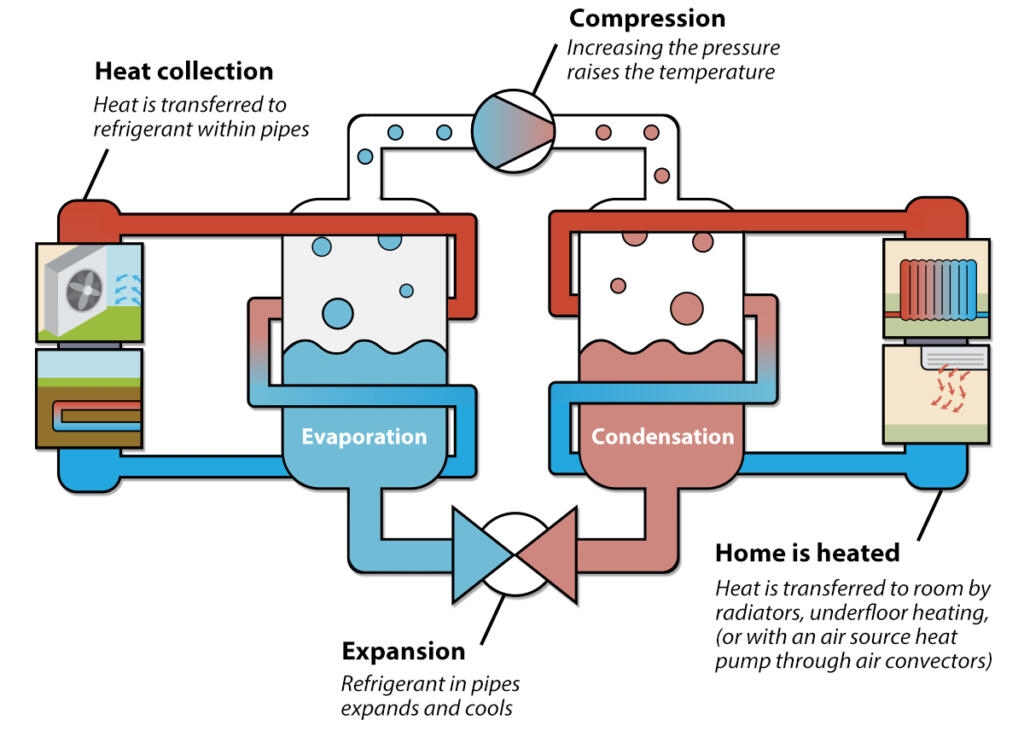
Heat Pumps take low-temperature heat from the air (in the case of ASHPs) or the ground (in the case of GSHPs). By passing this low-temperature heat through a refrigerant fluid and a compressor within the unit, the low temperature heat is compressed and amplified to temperatures of up to 55ºC. This high-temperature heat is then sent through the radiator and hot water system as it would do with a conventional boiler.
The system can deliver these high temperatures even when operating in ambient climates as cold as -20ºC. In simple terms, the colder the ambient temperature, the more we need to compress that air to create our desired temperature.
This may sound completely mad, but we have probably all experienced this for ourselves. If you have ever pumped up a bicycle tyre, you’ll remember the end of the pump starts gets hotter as you squeeze more and more pressure into the tyre – it is exactly the same principle and is a simple law of physics… when you squeeze air, you create heat as a by-product.
Air Source or Ground Source Heat Pumps?
Air source and Ground Source Heat Pumps are essentially the same technology. What differs is where they collect their low temperate heat from
Air Source Heat Pumps
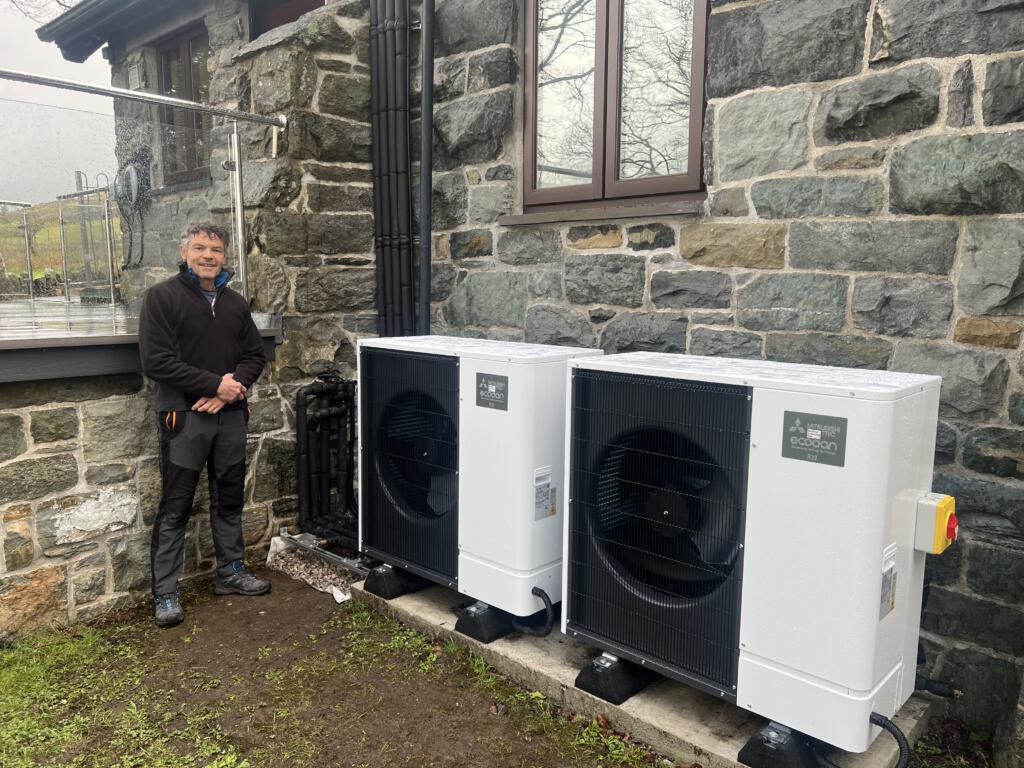
Air source heat pumps are one of the most popular renewable heating solutions for homes across rural and semi rural areas. The system involves installing a compact outdoor unit beside the property, which extracts energy from the air, compresses it and delivers heated water into the home for space heating and hot water.
For properties where internal space is limited, or where a straightforward retrofit is preferred, air source heat pumps are often the ideal option. The installation is discreet, efficient and designed to integrate with your existing radiators and hot water system.
Air source technology captures low temperature energy from the surrounding air. While efficiency naturally varies depending on the season and outside temperature, modern systems are engineered to perform reliably even in colder winter conditions. Many of the units we install are capable of operating in temperatures as low as minus 20 degrees, ensuring your home remains warm and comfortable throughout the year.
Efficiency is measured using an annual average figure known as SCOP, seasonal coefficient of performance. High quality systems can achieve an annual SCOP of around 3.5. In practical terms, this means that for every unit of electricity the system uses, it generates approximately three and a half units of heat. This level of efficiency is what makes air source heat pumps such an attractive long term investment.
From a running cost perspective, heating with a heat pump is rarely more expensive than relying on fossil fuels, particularly as energy prices fluctuate. When combined with solar PV, homeowners can further reduce costs by using self generated electricity to help power the system. Supporting your heating with solar is not possible with a traditional oil or gas boiler, making air source heat pumps a more future ready solution.
Ground Source Heat Pumps ‑ Horizontal Loops
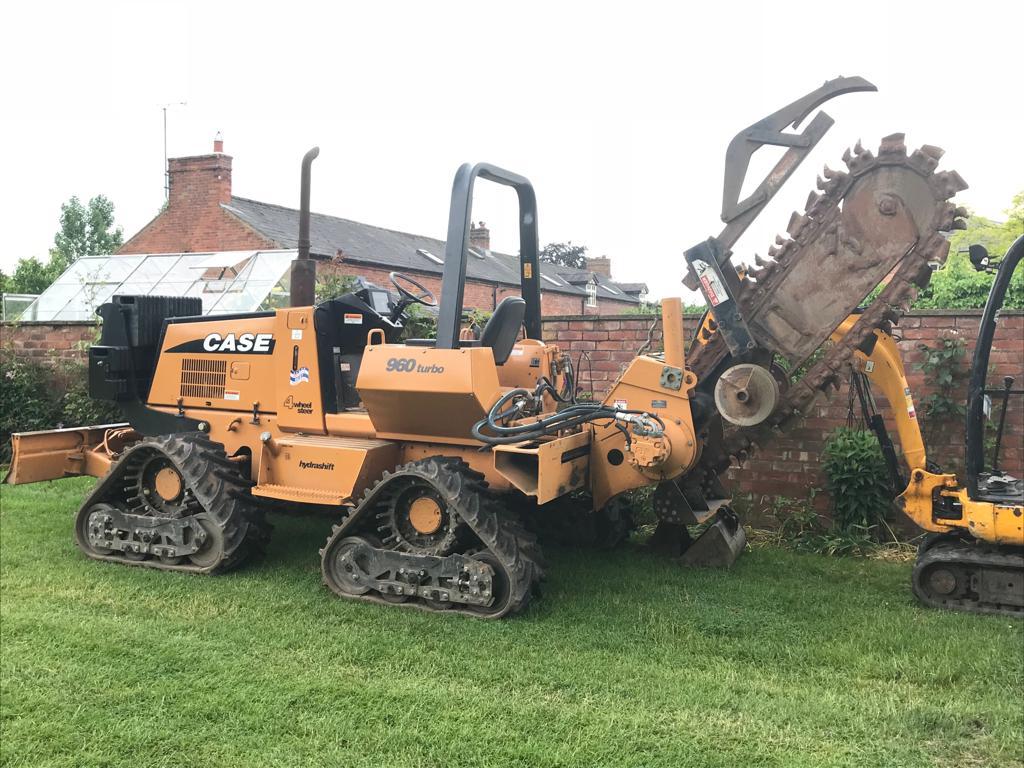
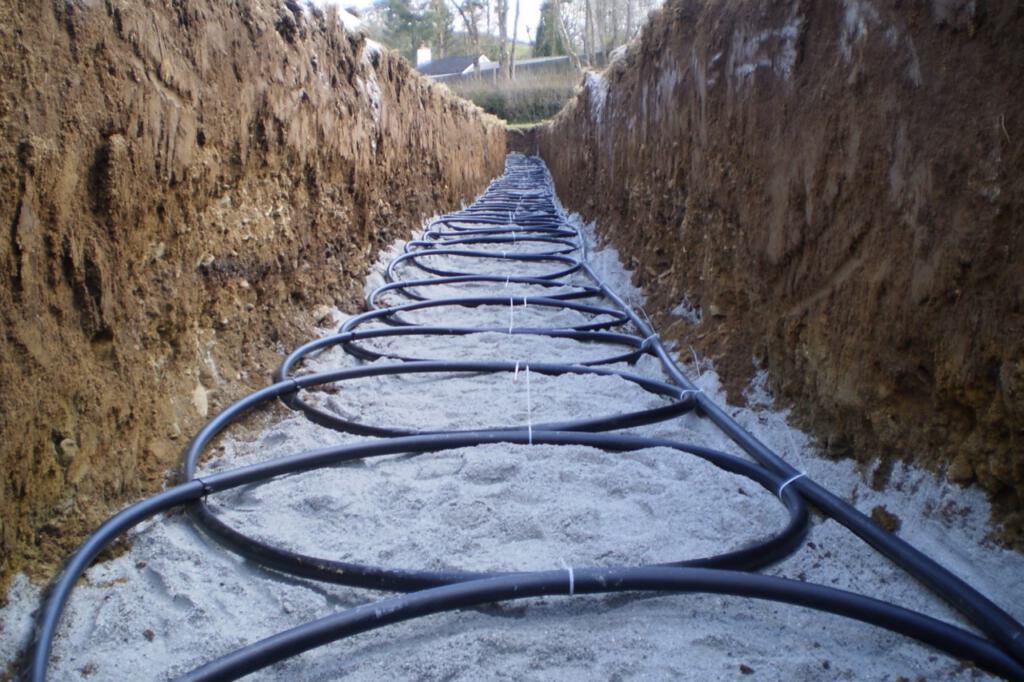
For ground source heat pump installations, linear ground loops are installed beneath the surface using conventional excavation methods, mechanical ploughing equipment or specialist trenching machinery, depending on the site layout and ground conditions.
The pipes are typically laid at a depth of around 900 mm to 1 metre below ground level. This places them beneath the frost line, which is the level at which the ground can freeze during severe winter conditions. By installing the loops below this point, we are able to consistently collect stable ground temperatures, usually between 0 and 10 degrees, even during colder periods.
Each loop is carefully spaced, generally allowing around two metres between adjacent trenches and approximately one metre between the individual flow and return pipes. This configuration ensures that low temperature heat energy is absorbed at a slower rate than the ground naturally replenishes it. In practical terms, this provides a sustainable and continuous supply of renewable heat energy for your property.
The ground loops are filled with a specialist heat transfer fluid that includes an antifreeze additive. This enables the system to safely collect and transport low temperature heat energy back to the internal heat pump unit, regardless of winter conditions.
Horizontal ground loops are particularly well suited to rural and agricultural properties. They are installed below standard ploughing depth, meaning farmland or garden areas can continue to be used as normal once the installation is complete.
Every ground source system is individually designed and sized to suit the specific property. Ground loop lengths are calculated on a site by site basis to ensure the correct volume of renewable heat energy is collected to meet the heating and hot water requirements of the home, farm or commercial building.
Enquiry Form

WE DO NOT USE SLINKY’S. These are a coiled version of our linear pipe-work. They are used/were designed for sites where clients do not have the required land for linear loops. Slinky’s are, in our opinion, a flawed solution. Coiling the pipe in the ground can result in the energy in the ground from being used faster than nature (sun and rain) can recharge it. The result is often areas of frost on the ground and sub-zero temperatures of heat-energy being sent to the Heat Pump. This results in a loss of efficiency, increased running costs and Heat-pump fatigue.
We adopt a simple technical guide line one installation of horizontal Ground loops: if you do not have suitable land-space you are not having horizontal loops! It is as simple as that. Air Source Heat Pumps or Vertical Bore Hole Ground Source should be considered instead.
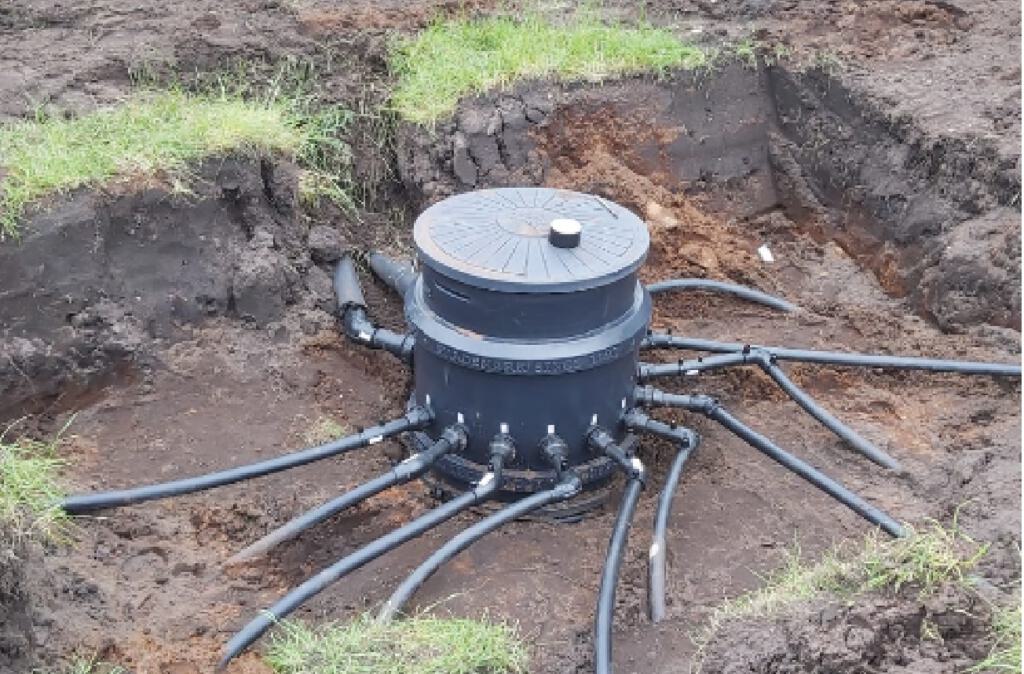
It is typical for a Ground Loop system to contain many loops. The Ground Loops are terminated in an external Manifold. This is a chamber that sits in the ground and allows for connection of multiple loops. Connections are Fusion welded, not Mechanical. These plastic-to-plastic welds cannot leak.
We then run a pair of larger diameter pipes (known as the Master Header Pipes) below ground towards the property for ultimate connection to the Heat Pump unit.
What land do I need for Horizontal loops?
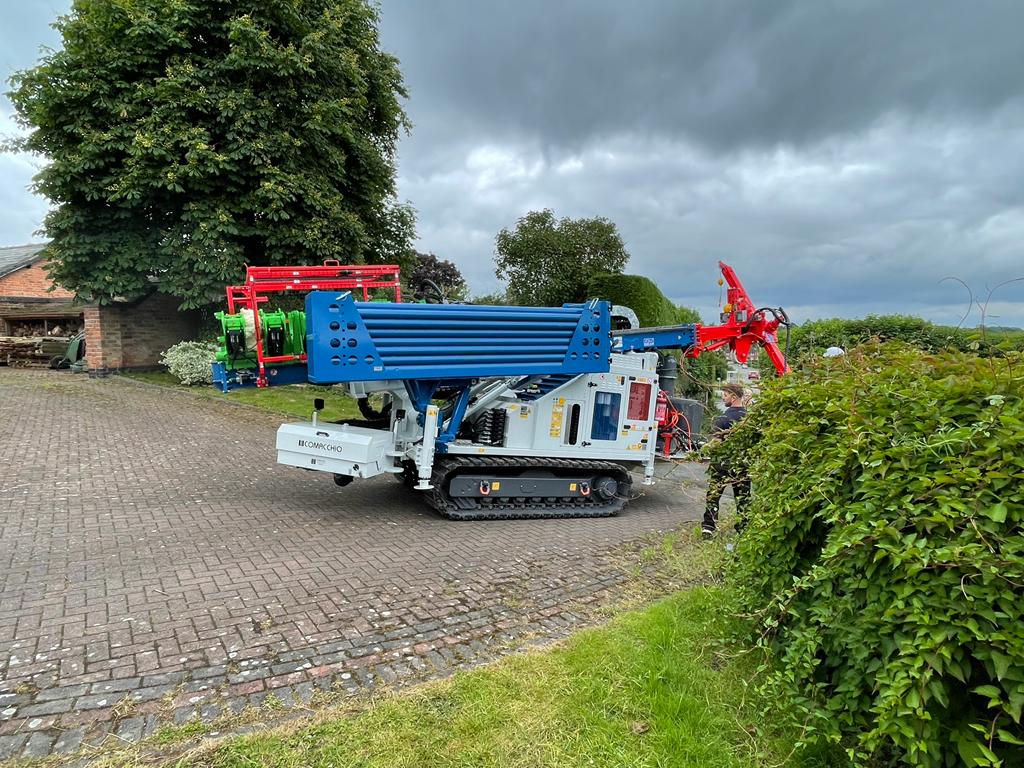
Ground Loop lengths are calculated and installed based on the Heat Load requirements of the site. To enable correct access to and around the site, we regardless recommend a minimum of 1acre be available. We also recommend a paddock is used.
Due to the excavation and heavy-plant nature of the work we would not recommend installing ground loops to formal garden areas. We do not recommend installation to wooded or orchard areas, as installing loops can often interfere with lateral or secondary tree-roots. As trees grow there is also risk of roots interfering with ground loops.
Ground Source Heat Pumps – Vertical Bore Hole Loops (VBHL)
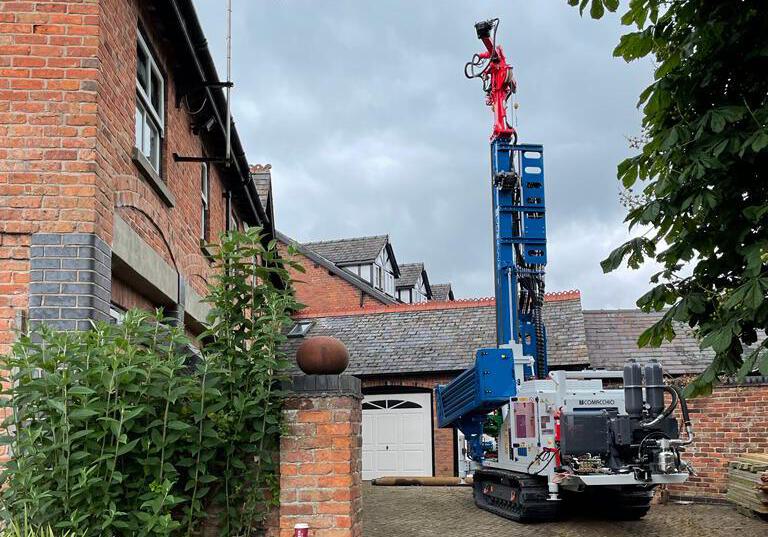
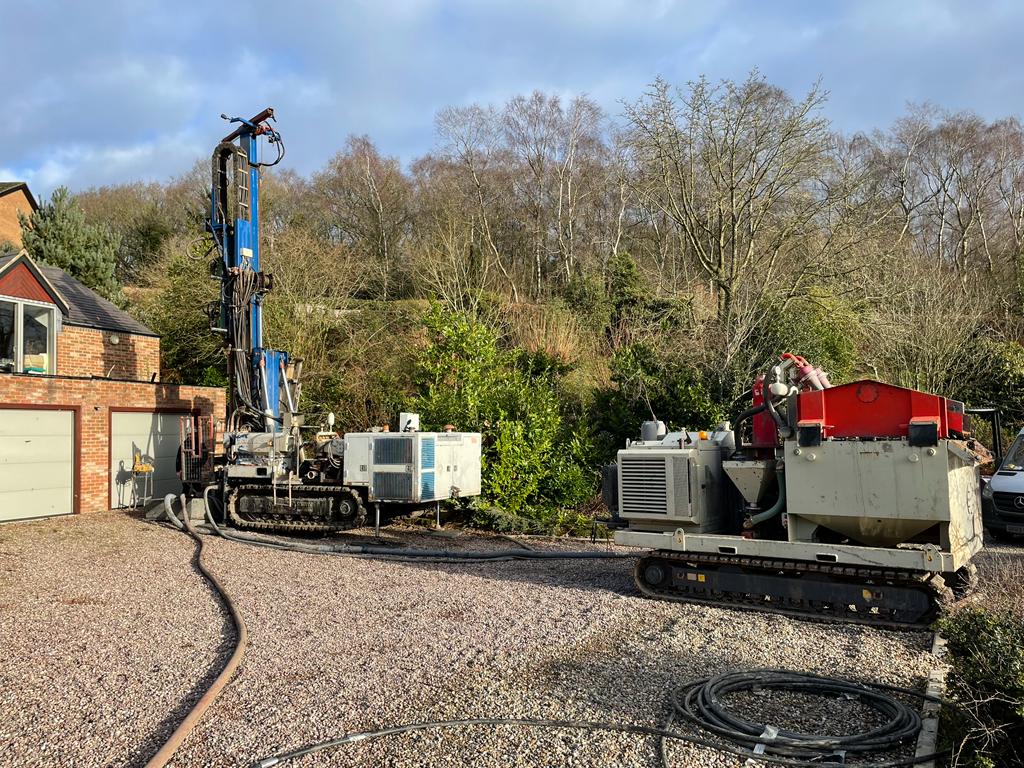
Vertical Bore Hole loops are the Premium installation method for Ground Collection loops. Unlike Horizontal Loops, a Vertical Bore Hole Installation involves a number of Bore Holes to drilled to depths of up to 150m into the ground (500-feet down). Low-temperature heat-energy loops are then lowered into the bore-holes. The bore holes are then filled with a thermal grout and capped off at the surface.
As with Horizontal loop installations, it is common for multiple loops to be drilled / installed to a site, with the pipework being taken below ground by our Groundworks teams to an in-ground man fold where they are fusion-joined. A pair of master header pipes then continuer below ground back to the property where the heat pump unit is sited.
VBHL has a number of benefits over Horizontal Loop ground installations.
Firstly, they can be installed in much smaller land ownership. It is common to install to driveways or gardens. Aside from access by the drilling rig and associated plant, physical excavation and disruption is reduced.
Secondly, the temperature in the ground at depths of 30m and lower is a fairly constant 10-12C, regardless of winter ambient temperatures. At those depths we are simply too low in the ground for seasonal effects to impact temperature in the ground. So, unlike Horizontal Loop heat-energy collection that ranges from 0C to 10C, with VBHL installations we have a constant 10-12C of latent heat beneath our feet that we can tap into, 365 days per annum.
Access
Access requirements exist for both forms of Ground Source Heat Energy Collection. If site can be accessed by a tractor it is likely we can access with out plant. Contact us to discuss requirements in more detail, where we can advise of what may or may not be feasible.